

Field Notes: Protest at Monument Square
An hour of photographing resistance in Portland, Maine.

Author’s Note:
Here we are at the start of February, and I’m just getting my first Substack of the year out. It’s not that I haven’t been writing—I have—but I’ve struggled to match this moment. How am I supposed to carry on producing lighthearted content as if nothing’s happening, when I’ve literally seen masked federal agents shove a man into the back of an SUV on my commute home from work? (My infant daughter was in the car—otherwise, you can guarantee I would have stopped and documented.)
Things aren’t normal. Quite frankly, things aren’t okay.
I’ve been working on a new Substack series, Field Notes, where I break down a photo shoot: the thinking behind it, the images that worked, a few that didn’t, and how I approach telling a visual story. Most of the Field Notes to come are light—photographing Maine’s coastline, landscapes, and quieter moments—but I’m starting with something that feels more urgent.
Below is a short essay on Portland showing up to protest ICE. This is the Maine I’m proud to call home. While I’ve typically refrained from telling political stories, I’ve come to see that documenting Maine—and telling Maine stories honestly—is part of the job.
I hope you enjoy it, and I’d appreciate hearing your feedback on this format.
—Cam
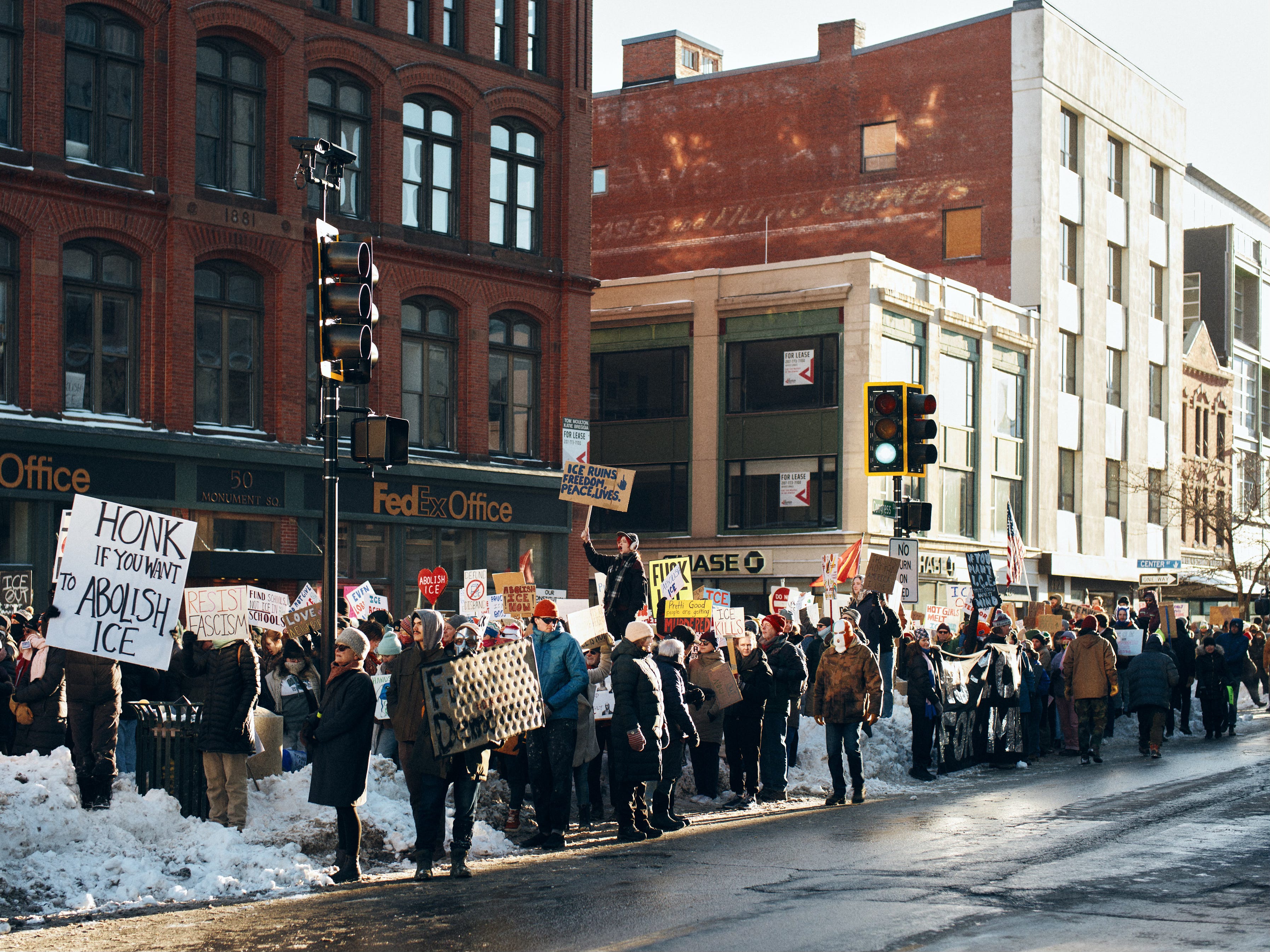
Fri · Jan 30 · 2:21 p.m.
The protest begins in forty minutes, so I start gathering my gear. Besides warm layers—it’s 18ºF this afternoon—I pull out my cameras. I’ve learned that a minimal setup is ideal for protests: with so much movement and noise, switching lenses or bodies quickly becomes impractical. I don’t need all three cameras laid out in front of me—but which one?
On one end of the spectrum is my Fujifilm X-Pro3: a rangefinder-style body paired with a fixed 40mm f/1.8–equivalent lens. Rangefinders and fast primes have long been favorites among photojournalists for good reason—they’re compact, robust, and simple. After buying the X-Pro3 in 2024, it quickly became an extension of my body; shooting with it felt more reflex than thought. It’s a perfect lightweight carry, but it has limitations: the least accurate autofocus of my cameras, a sometimes… let’s say creative exposure meter, and the least flexible files in post.
Then there’s my Canon R5—my longtime workhorse. Steady. Competent. Uninspiring. I’ve written about it before: it’s hard to complain about a camera that does its job without fuss day after day, even if it offers little in the way of joy. What it does offer is my widest selection of lenses, fast and reliable autofocus, and excellent RAW files.
And finally, the newest addition to my arsenal: the Fujifilm GFX 100S II. This medium-format camera is becoming my primary tool, with caveats. It’s inherently slow-paced—when you’re shooting 100-megapixel files, you don’t shoot casually unless you enjoy filling hard drives (each image is ~100 MB). But it produces the most compelling images I’ve ever made, and I’m currently obsessed with the medium-format look it delivers.
After a few moments of deliberation, I settle on a plan: I’ll primarily shoot with the GFX and two lenses—a wide-angle zoom and a 50mm f/1.0–equivalent prime. Just in case, I’ll also slip my Canon and two lenses into my backpack. I’m still comforted by the idea of a familiar backup.
(Future Cam’s Note: Stop carrying unnecessary camera gear you won’t use! Listen to your own advice, dummy: “I’ve learned that keeping a minimal setup is ideal for shooting protests.” I never even touched my Canon camera…)
Fri · Jan 30 · 2:44 p.m.
Creativity is a muscle—it needs regular use to stay sharp. It also needs a warm-up. Very rarely are the first frames of the day the best, so I’ve learned to start with “easier” storytelling elements before stepping into the main action. This is especially true when photographing people—I want to be in the flow. There’s nothing worse than fumbling with your camera and missing a fleeting, perfect moment.
On my way into the office earlier, I noticed several mailboxes and utility boxes tagged in yellow spray paint, denouncing ICE. I know these won’t be the most compelling images of the day, but they’re a good place to start. If they work, they can function as B-roll—context-setting details that support the larger story. There’s no pressure.
I mount the 50mm f/1.0–equivalent lens on the camera. It’s manual-focus only, with a focus plane less than a centimeter deep when shot wide-open, so sharp images require intention—and a warm-up. I make a few frames. Nothing remarkable. But I can already feel the rhythm of manual focus returning, even with gloves on.


Fri · Jan 30 · 2:56 p.m.
I stride into Monument Square, taking note of the light, landmarks, colors, and shapes—framing shots in my head. Nothing in camera yet, but ideas forming. When working a location, whether a protest or a wedding venue, having a mental map of backgrounds, potential frames, and light direction can make or break a shot later.
I’m so focused on surveying that I miss two friends to my right until I hear, “Hey Cam!” A few minutes later, I run into two more. Portland is a small city, and the community-focused buzz here feels electric.
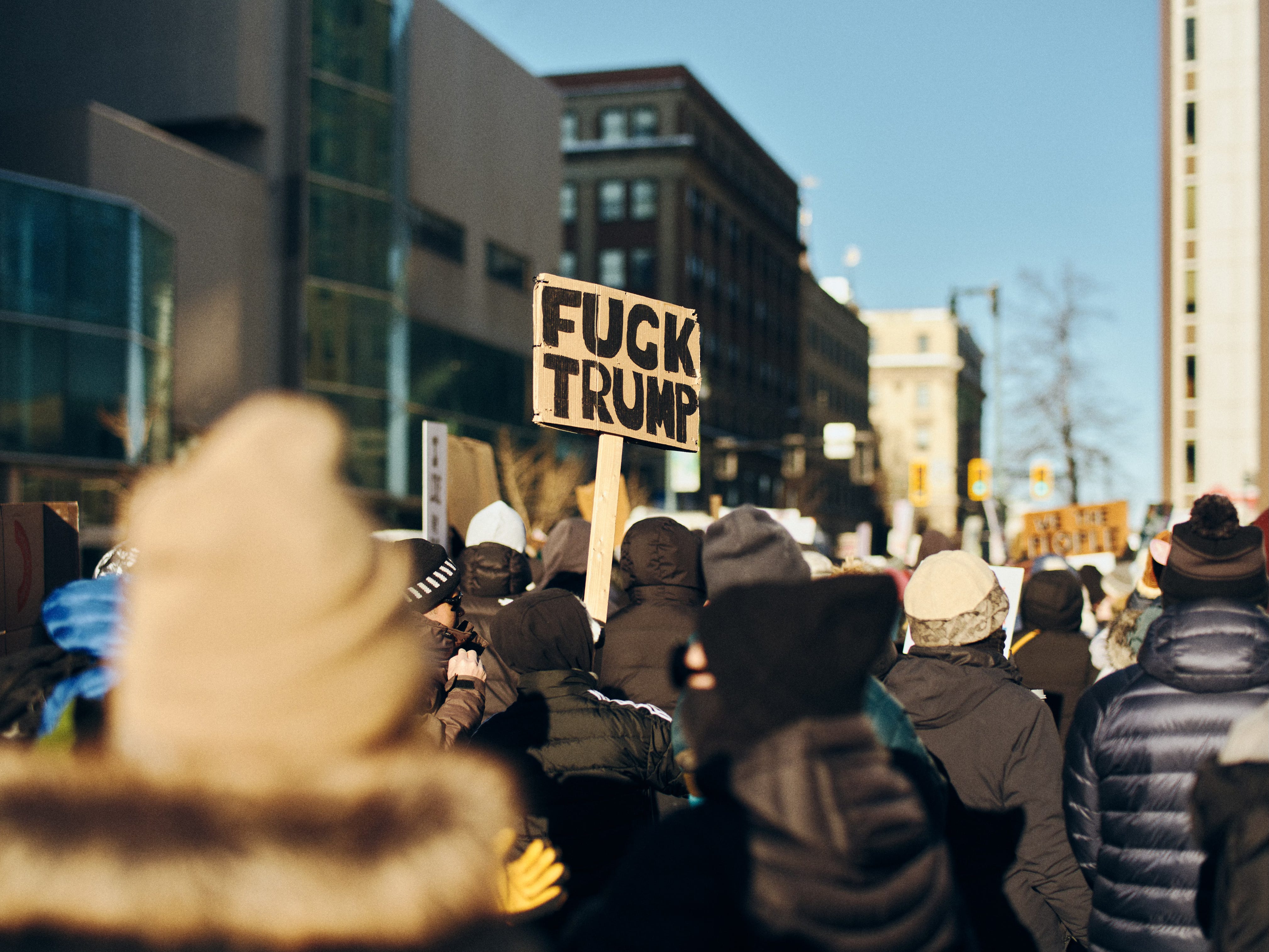
My first image of the protest comes as a large group of protesters walks into late-afternoon light spilling down Congress Street, one Fuck Trump sign held high and catching the sun. I miss focus on the first frame, but nail it on the second. Okay—I’m on the board.
Behind me, a protester in a black fleece bucket hat raises a sign mounted on a hockey stick: If you can’t skate it, I hate it! It catches my eye.
“Can I get your portrait?” I ask. They nod. I lift the camera—and they raise the sign higher, straight out of the top of the frame. I can’t step back; the crowd is too dense. I can’t zoom out. Damn.


I slide a few steps to my right, where there’s a small pocket of space, and make another frame. The sign fits now, but the composition doesn’t sing. Time to change approach. I circle behind them and finally find an angle I like. The sign is less interesting from this side—FUCK ICE isn’t as inventive—but now I can see the hockey stick clearly, with a swarm of protesters layered behind.
This one works.
Fri · Jan 30 · 3:01 p.m.
The crowd starts to swell. I’m a big guy wearing a backpack and carrying a camera, and I don’t slip easily through dense crowds. I know that with my preferred roaming photographic style, I’m about to be pushed to the more open spaces at the periphery of Monument Square. Before that happens, I press toward the center to document the protest’s core.
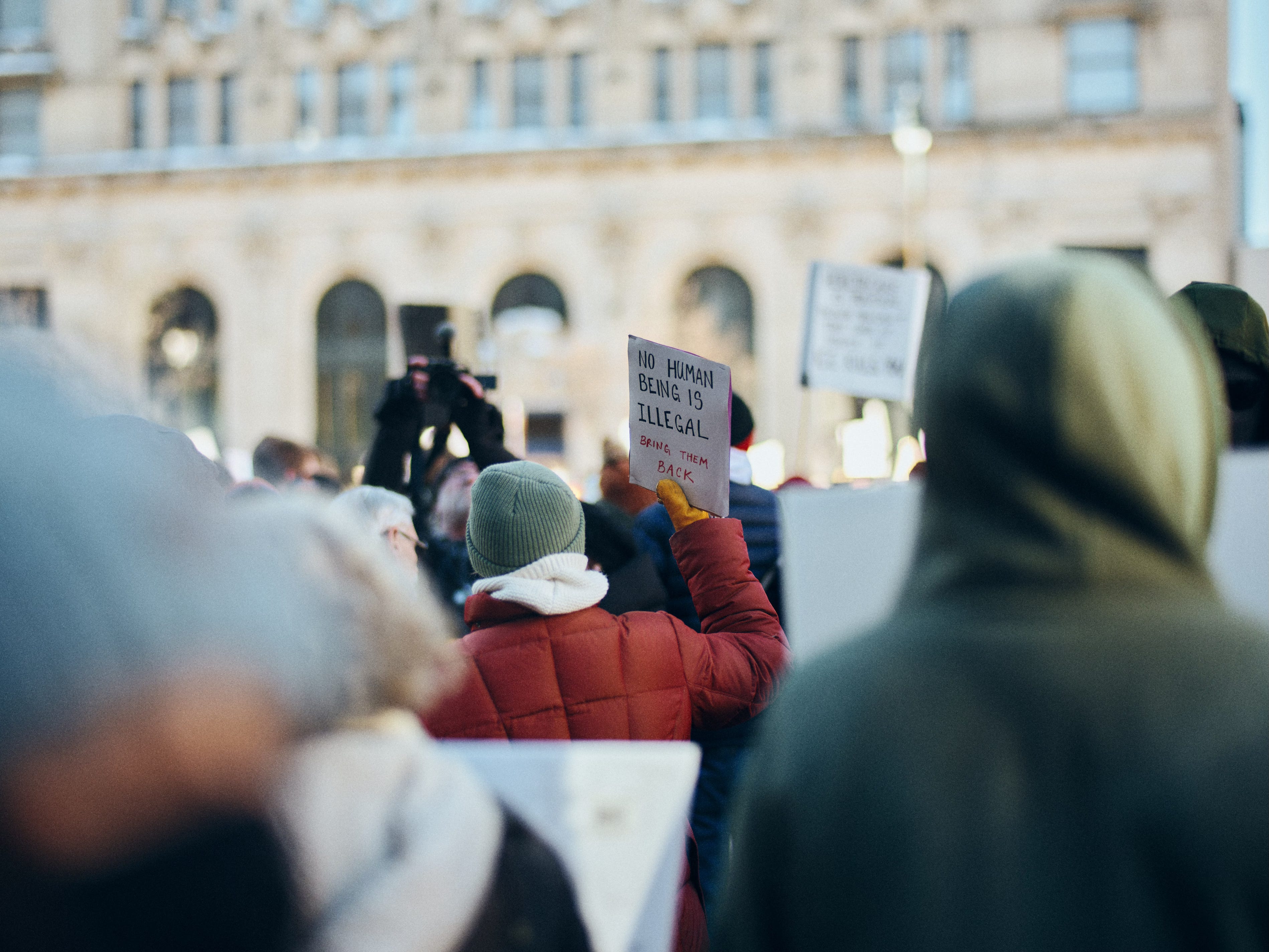
With the 50mm f/1.0–equivalent lens, I can use shallow depth of field to isolate subjects—a useful tool in an environment this busy. I work a series of images with single focal points—often signs or individual protesters—trying to convey the shoulder-to-shoulder density of the crowd. The lens also compresses space nicely, pulling the glass and stone façades of the Time and Temperature Building and the surrounding blocks upward in the frame. The effect anchors the protest in the city itself.
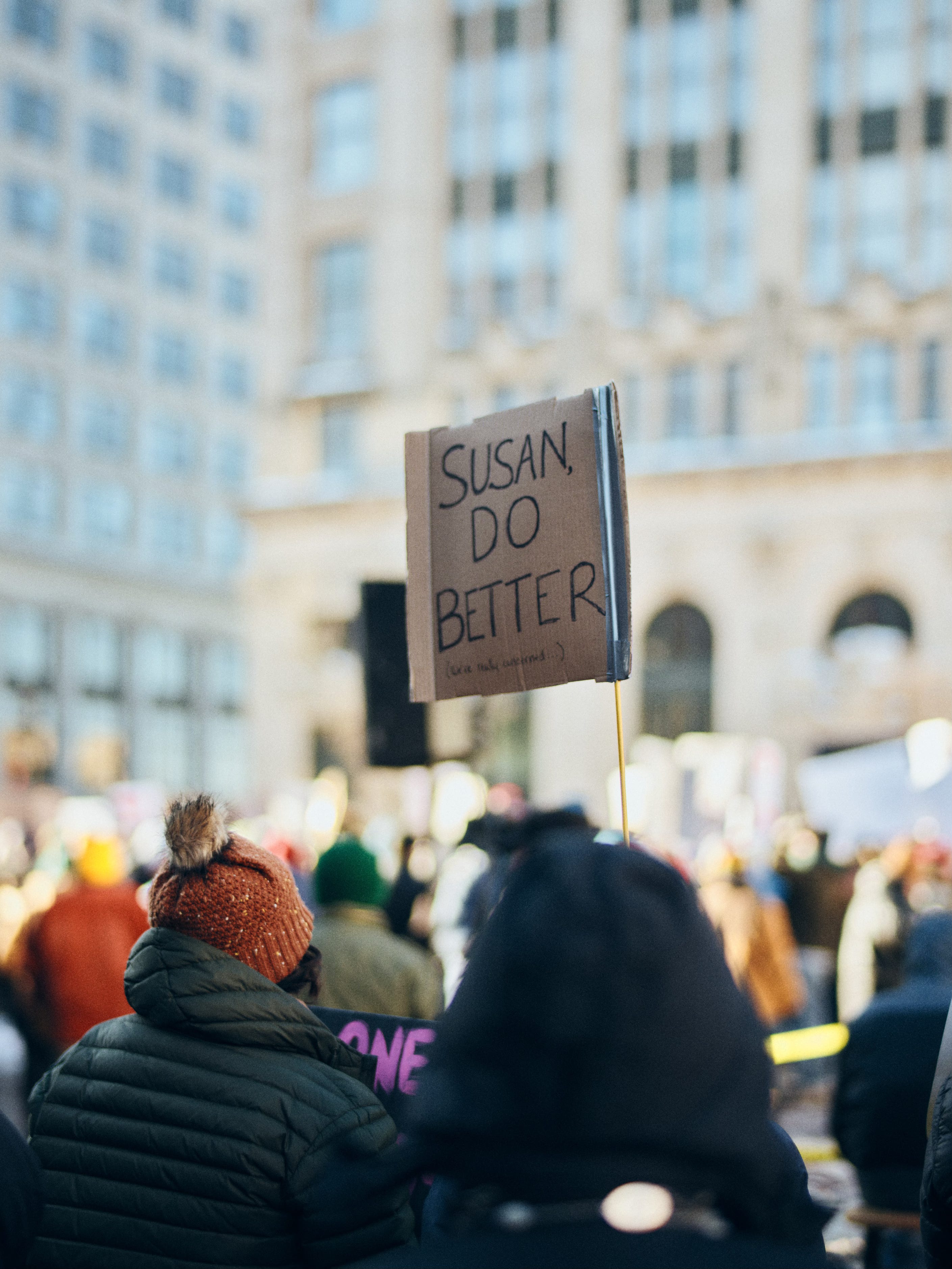
I start to worry I’m leaning too hard on the narrow depth-of-field look. Time to change my approach. I work my way back out of the crowd to switch lenses and reset.
Fri · Jan 30 · 3:11 p.m.
I switch to my wide-angle zoom—a 24–50mm f/3.2–equivalent lens. Without a shallow depth of field to clean up the frame, I need to think differently.
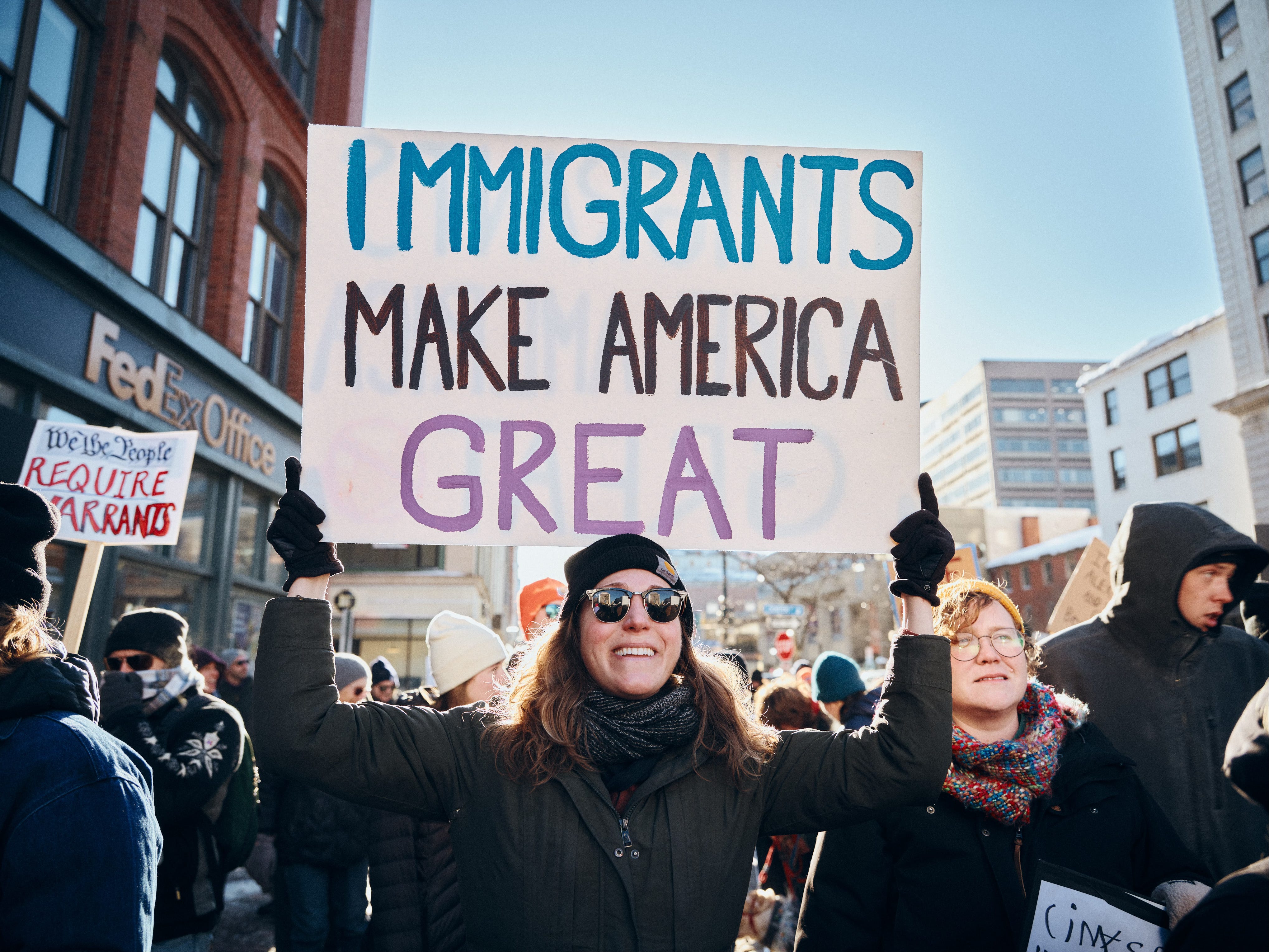
I start with a backlit portrait of a protester holding a sign that reads Immigrants Make America Great. I shoot it at 24mm—closer and wider than I’d normally use for a portrait—but the perspective gives a stronger sense of scale and place than the earlier 50mm images.
My attention shifts to the monument at the center of Monument Square. There’s a powerful metaphor here: a memorial to Portland’s “brave sons who died for the Union” during the Civil War. It strikes me that there’s an uneasy poetry in gathering beneath a monument to people who once resisted regressive ideas, fought for human rights, and paid dearly for it. Standing here now, it’s hard not to wonder—again—what resistance will cost.
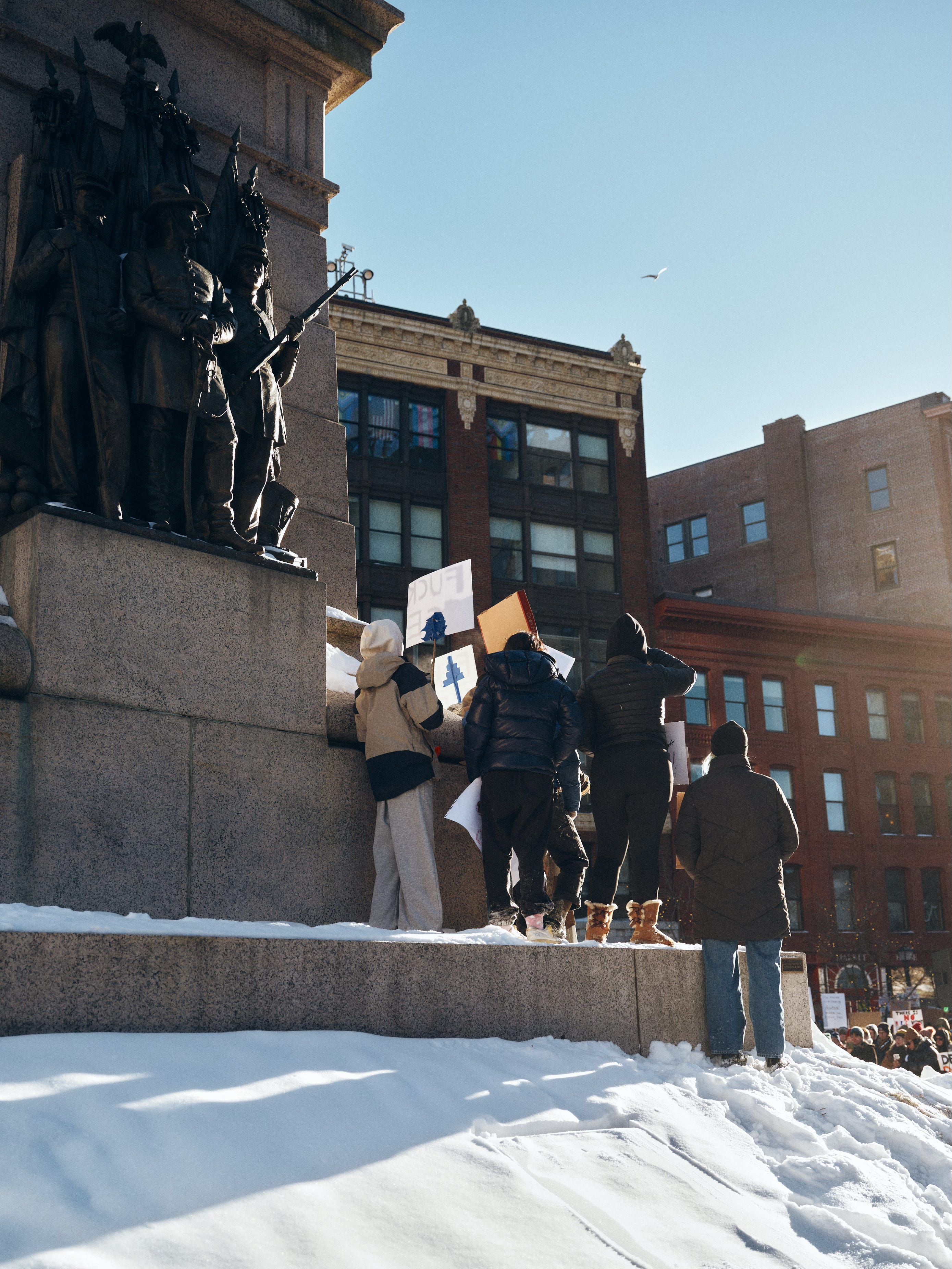
I notice a striking symmetry between the bronze soldiers clustered along one side of the monument and a group of young men holding signs on the front tier. I start from behind, the protesters’ anonymity contrasted against the bronze figures, but without the signs, the image loses its force.
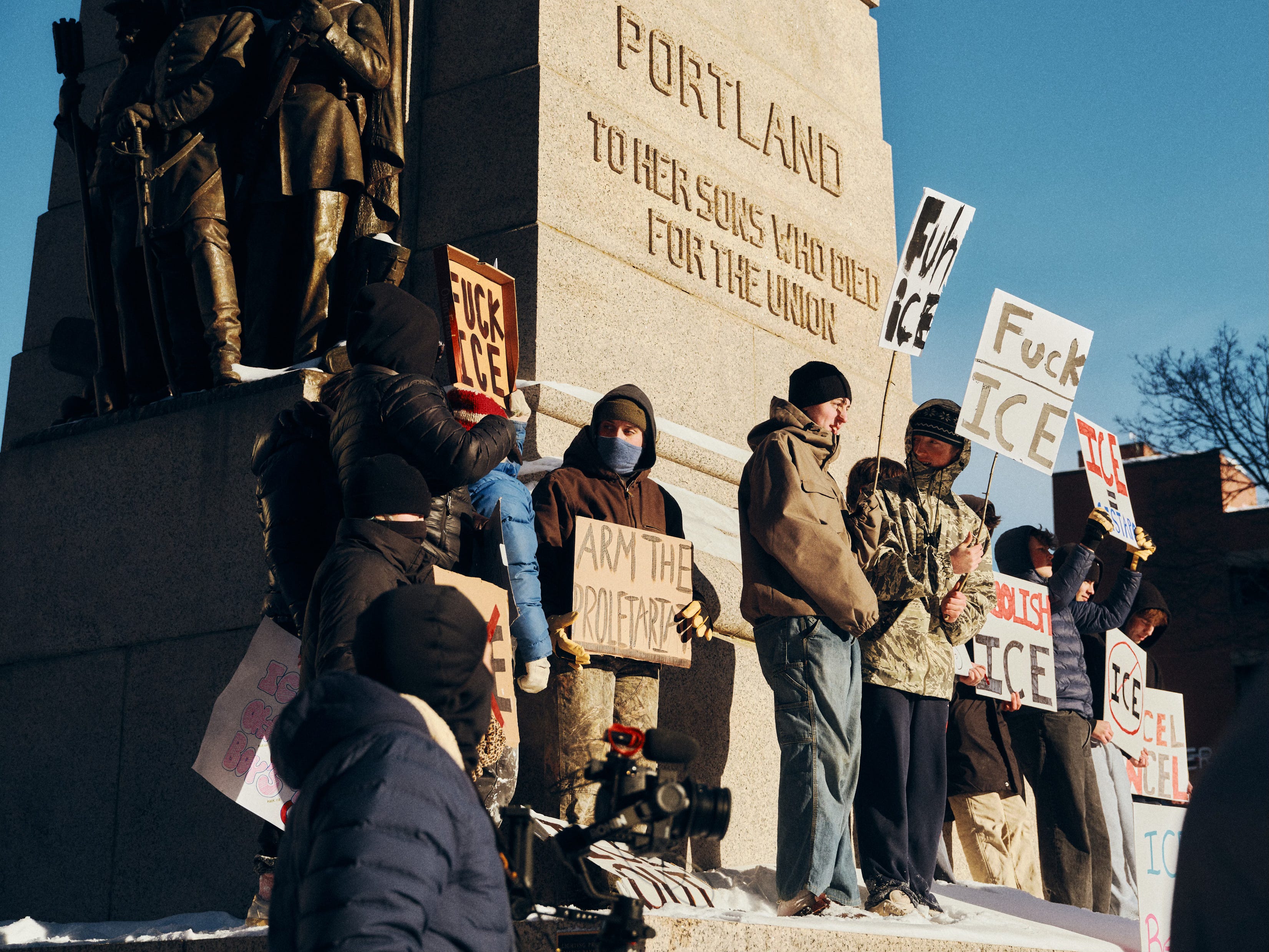
I move to the front. The signs are visible now, as is the text carved into the monument, and the parallel becomes clearer—but I can’t find a frame that includes the cast soldiers in a way that works. I’d need to push through a hundred people to do it. That’s not happening. Some images stay in your head, I guess.
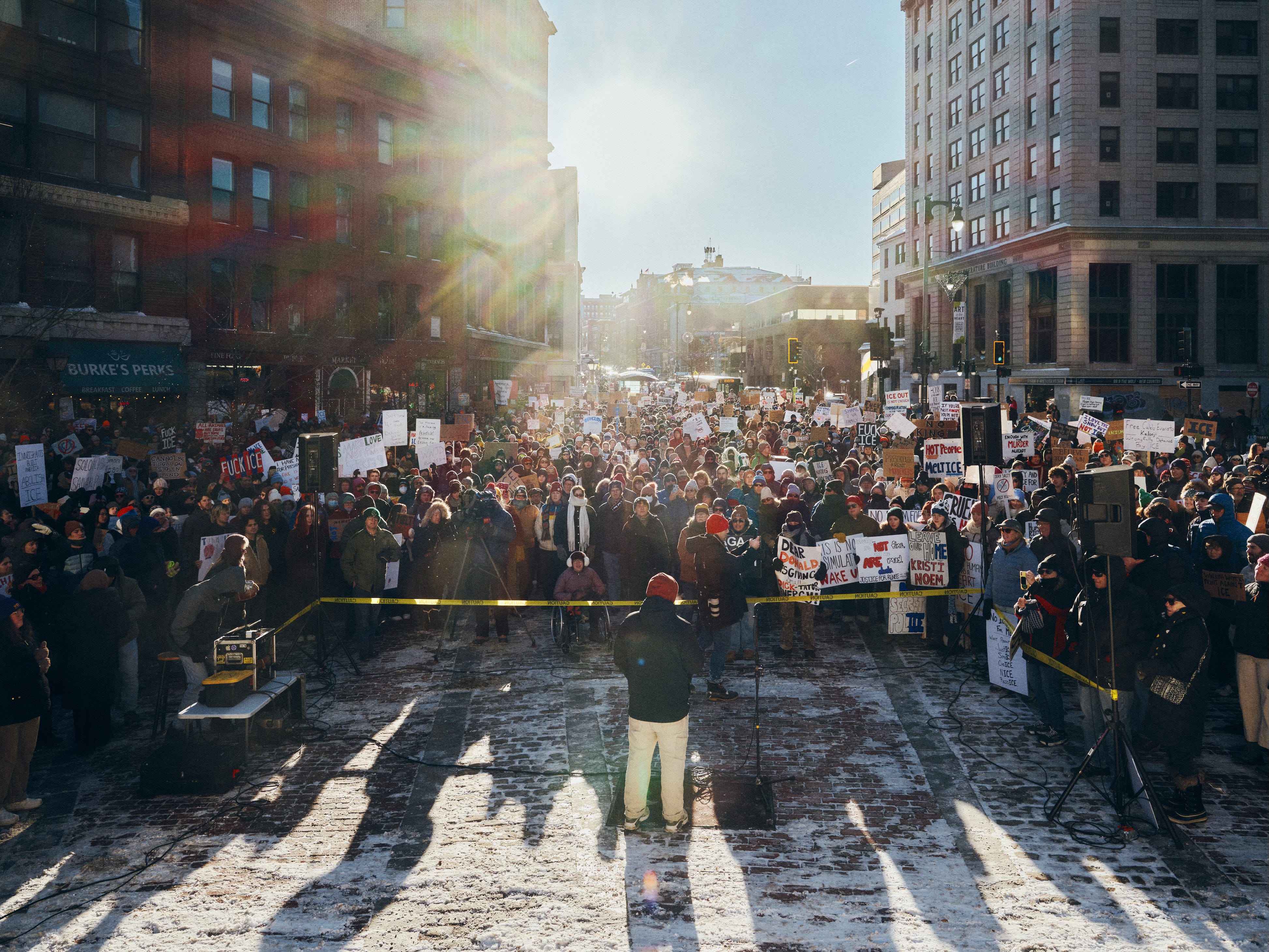
I try once more, climbing the icy, snow-covered slope of the monument itself—more treacherous than it looks. From the top, it’s clear I won’t get what I imagined of the protesters on the monument. But I do have a commanding view of the crowd and the speakers. These will be the establishing frames—the images that describe the whole scene in a way shooting from the ground never could.
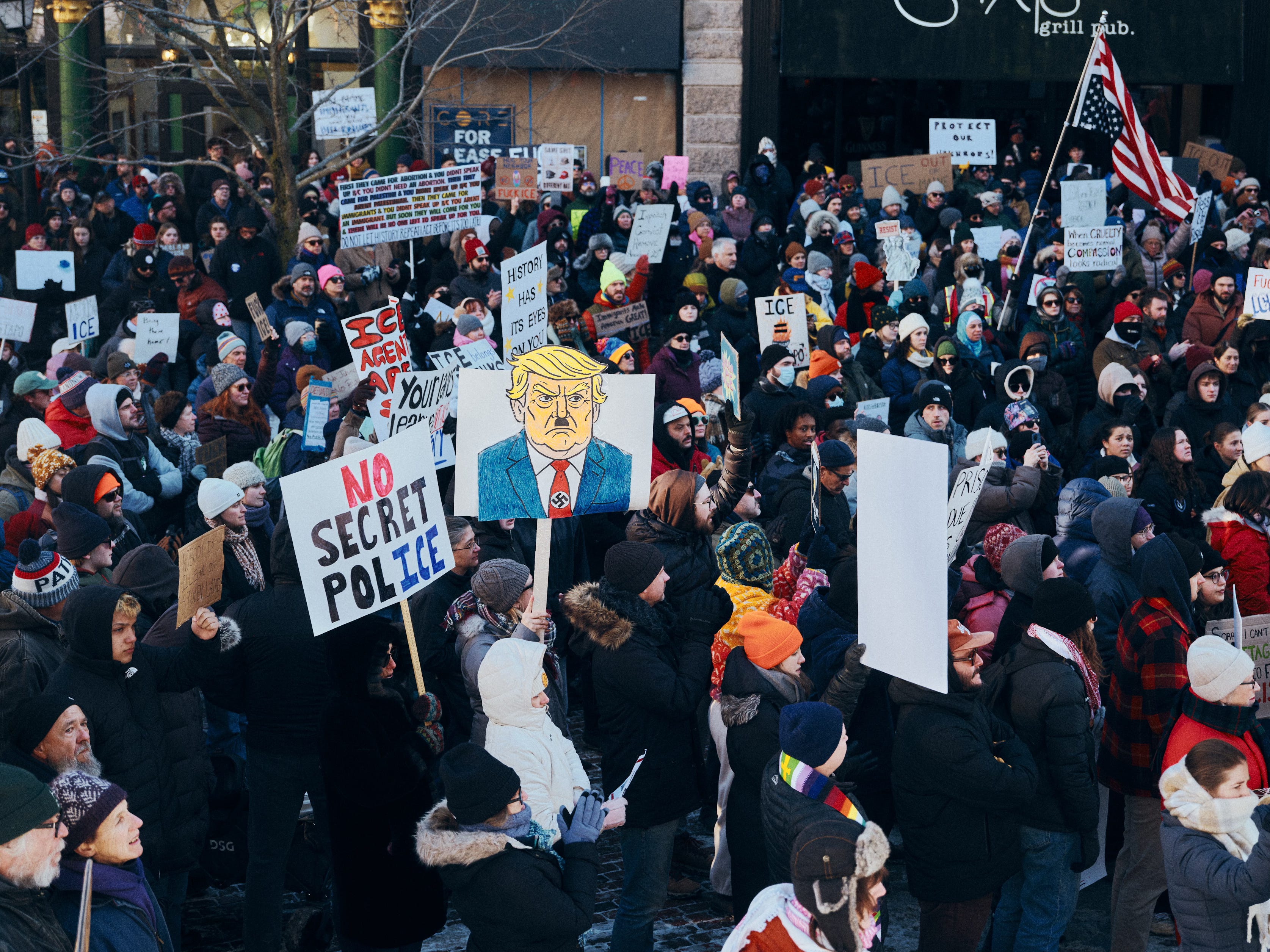
I work a range of compositions, some wide, some tighter. Shooting into the sun, I stop down, hoping for a starburst, but end up with a lens flare instead. It works. The frames are clean, legible, and expansive.
Still, as solid as these are, I can already feel myself wanting the character and intimacy of the 50mm again.
Fri · Jan 30 · 3:29 p.m.
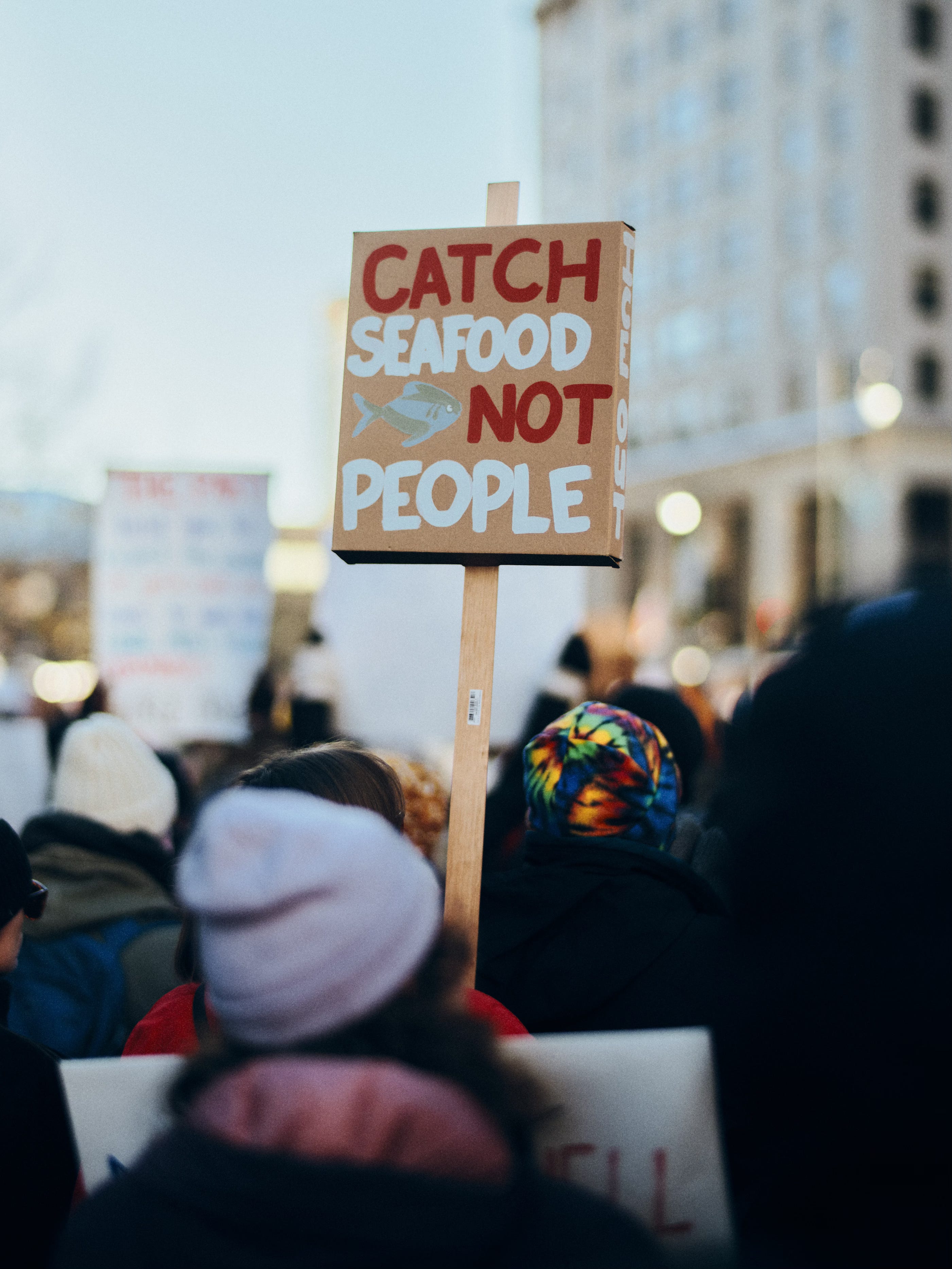
I’m in the flow now—working fast, frame after frame. For the most part, I’m nailing manual focus, though a few images lean soft. I move through the crowd, making portraits, signs, and even one attempt at a shallow–depth-of-field panoramic to capture the scale of it all. It looks great on a high-resolution monitor; I’m less certain how it will translate to phones. That’s a problem for later.
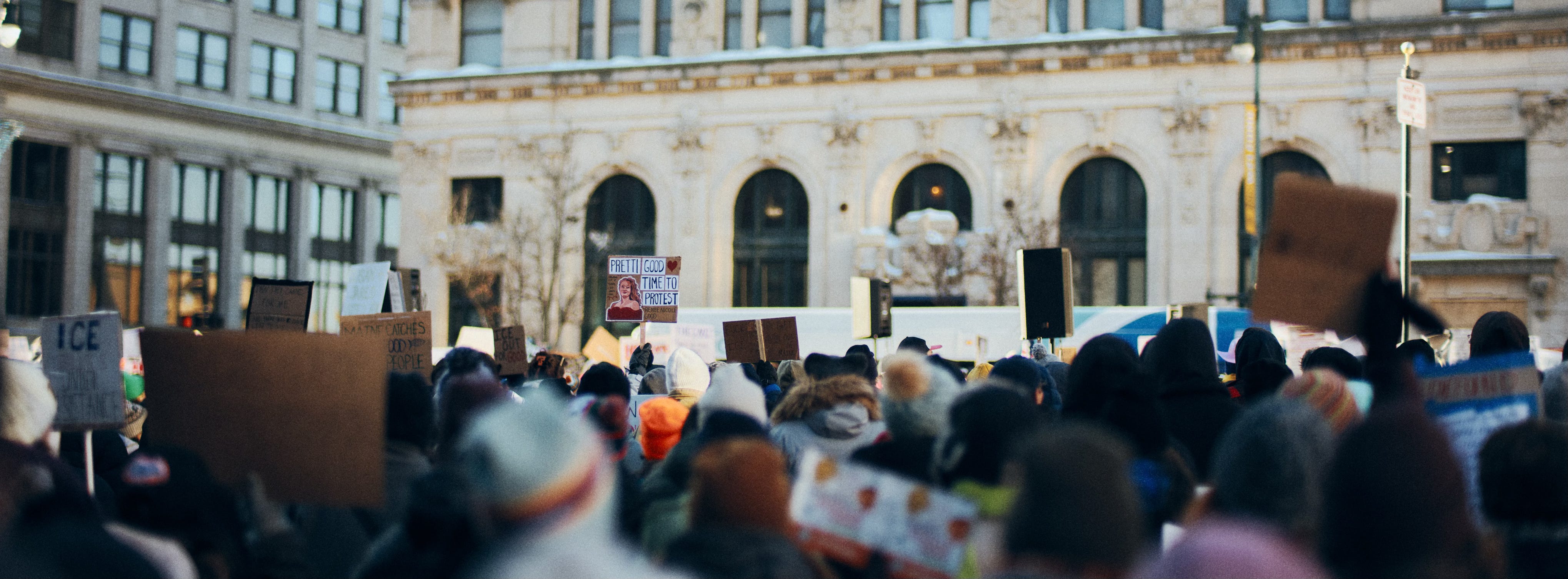


This is where some of my favorite crowd images come together—interesting faces, smart signs, good light. The rhythm feels right.
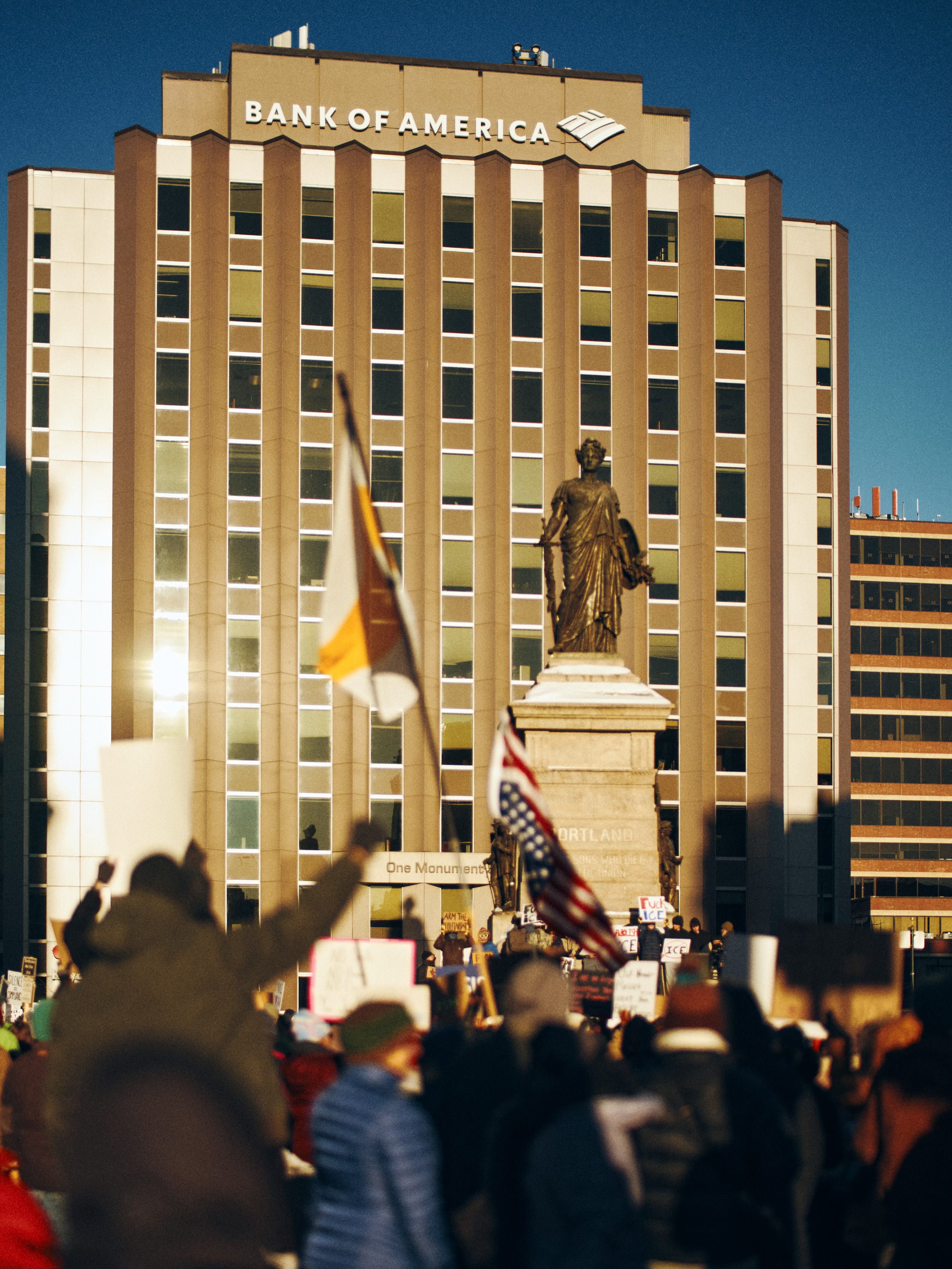
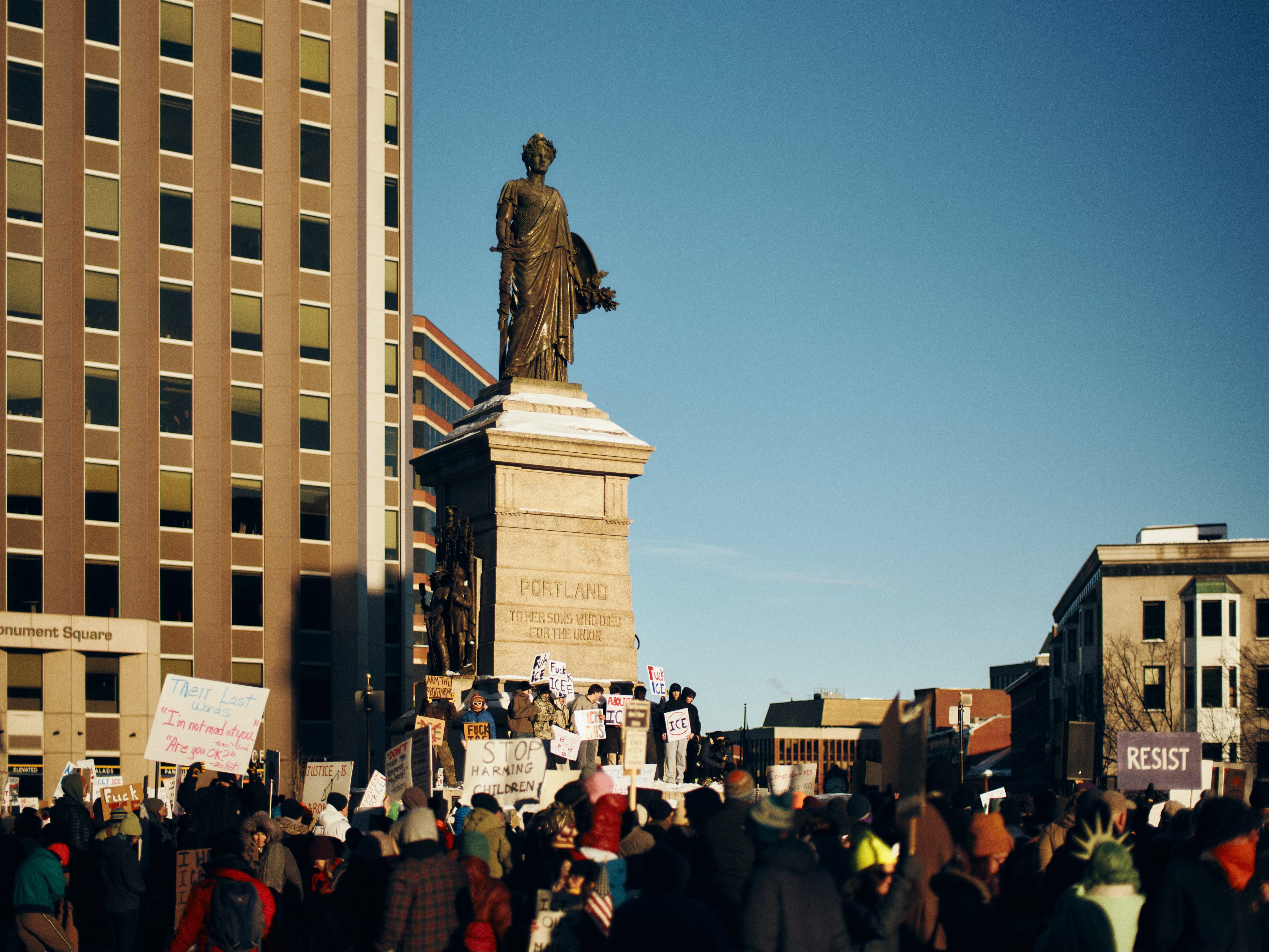
Eventually, I’m pulled back to the monument. A new tension jumps out at me: the speakers lean anti-capitalist, while a Bank of America logo looms over the entire scene—even the monument itself. If that’s not America, I don’t know what is. I never know whether viewers will follow this kind of visual argument, but that’s beside the point. The intent is clear to me. These may not be my strongest images, but they say something.
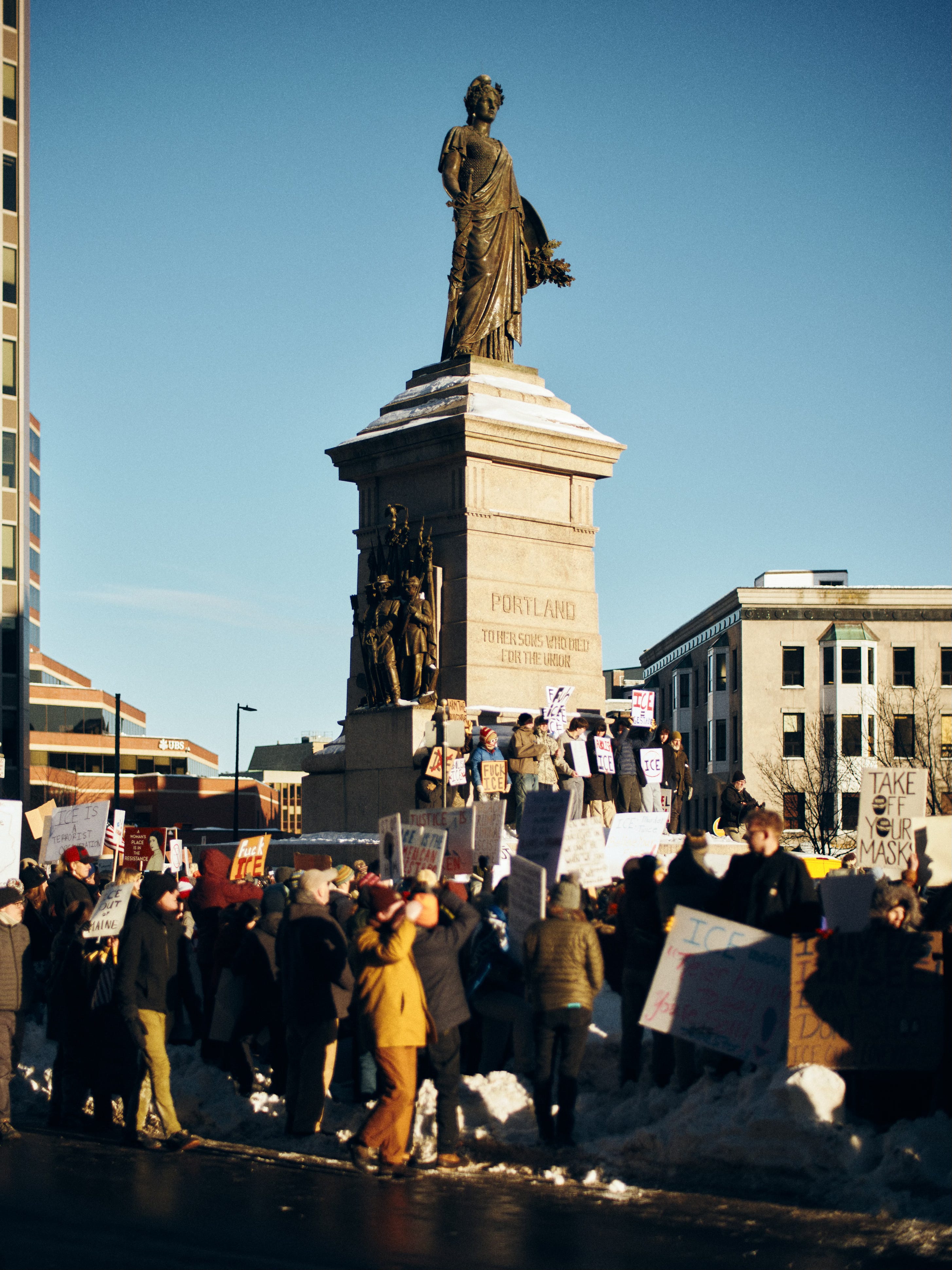
I move across Congress Street and try again. Now we’re getting somewhere. I finally have a composition that holds both the monument and the crowd. The diagonal edge of the road bothers me, though. What if I cut the midground entirely—frame the monument with two completely out-of-focus protesters in the foreground? I try it. That works.
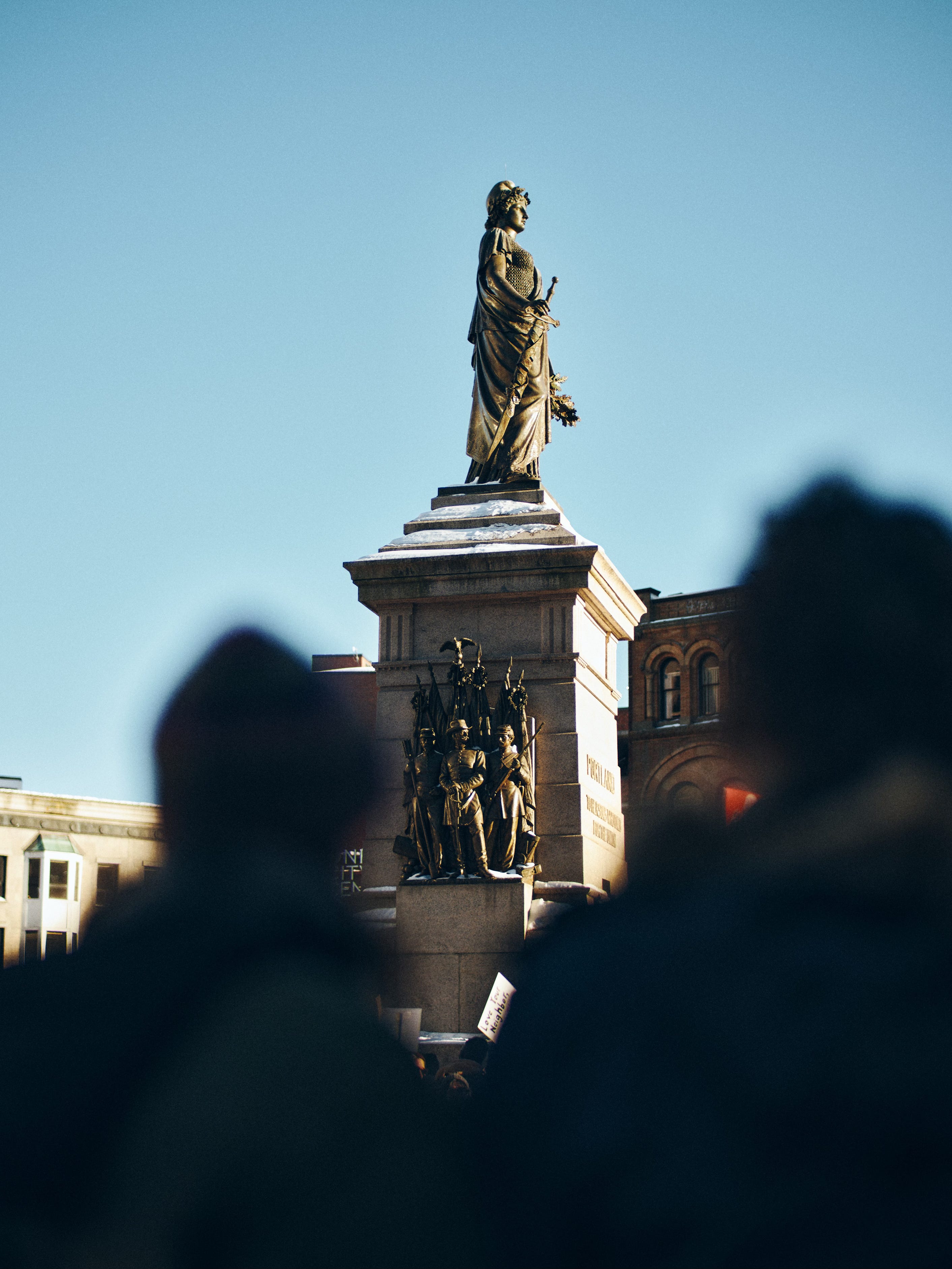
I make a few more variations. One of these is the frame. I’m pretty sure.
Fri · Jan 30 · 3:46 p.m.
Time is slipping by, and I realize I need to head home soon. I run through a mental checklist—what am I missing?
Shit! I forgot the businesses.


Earlier, I’d noticed a few spots offering free soup and hot chocolate to protesters—small, generous gestures that felt like an important counterpoint to any anti-protest rhetoric. I hurry back to where I saw Cheese Louise set up and make a few frames. They’re rushed. Several are out of focus. I don’t think I did this part of the story full justice.
That’s the reality of most shoots. You rarely get everything exactly right. The goal is to come away with enough to tell the story. Maybe these images won’t lead, but if they support the larger narrative, that’s enough. I think they do.
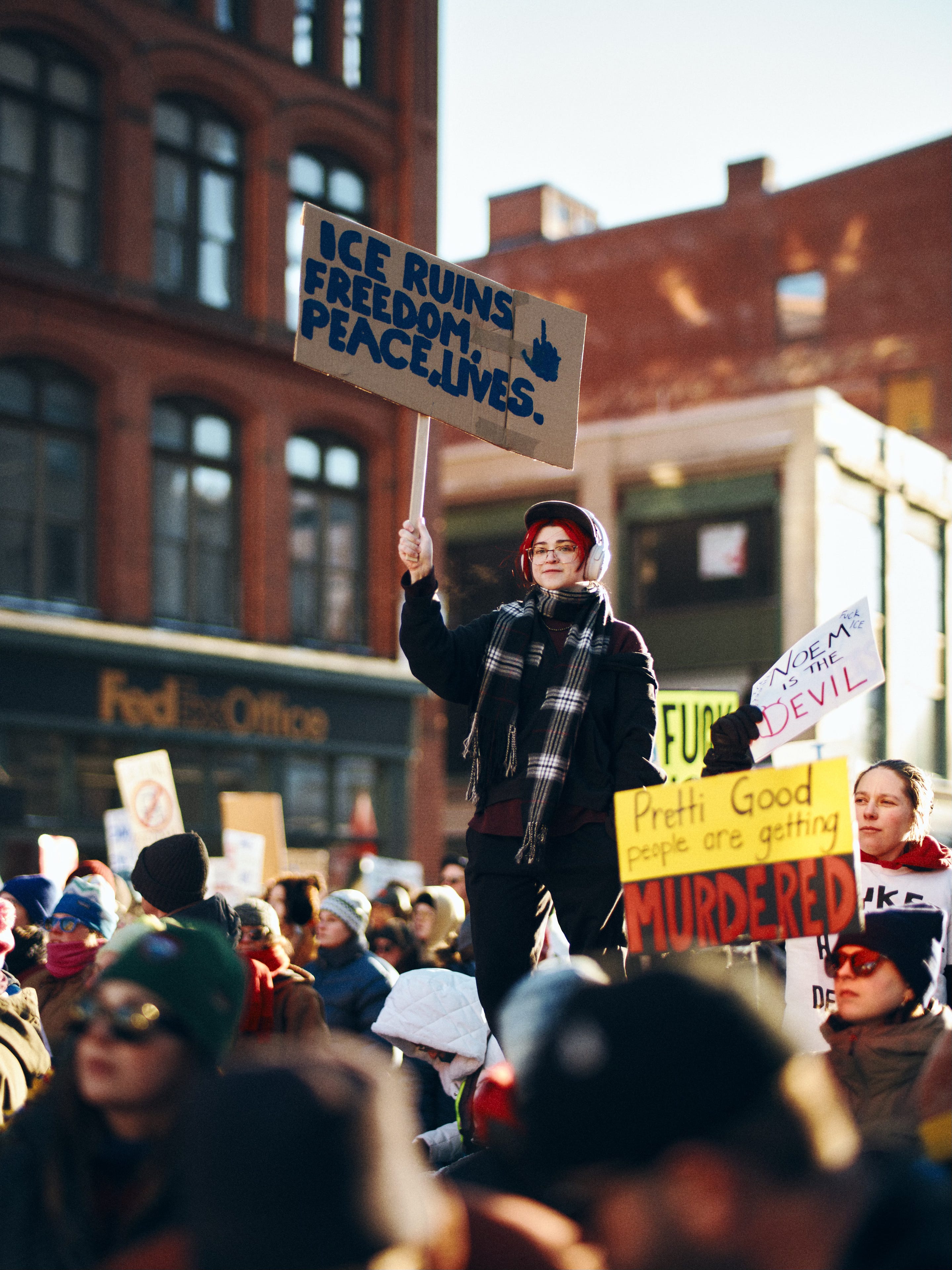
As I start to leave, I keep my camera out. You never know. Two of my favorite frames of the day come in these final minutes. First: a protester standing atop what I think is a bollard, rising above the crowd—open, friendly, unmistakably resolute. This is how I picture resistance.
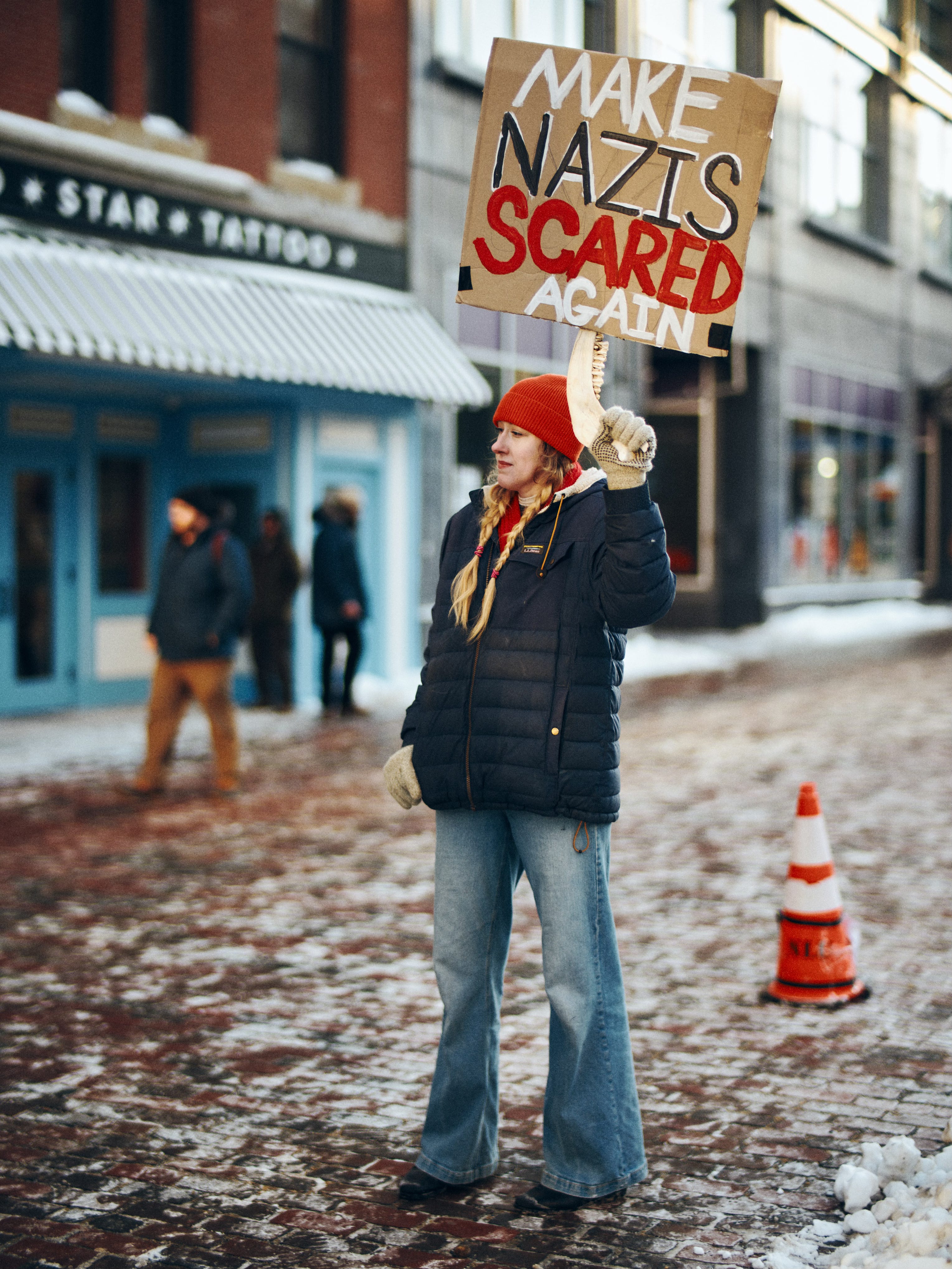
Then, walking back up Congress Street, one last portrait: a protester holding a Make Nazis Scared Again sign, taped to what appears to be a whale jaw. Fascinating. Colorful. Powerful. A fitting way to end an hour of shooting.
Fri · Jan 30 · 4:12 p.m.
I’m back in the office. My dog, Kiwi, is very pleased about this development.
I dump the cards, cull quickly—forty images from the 281 I shot—add a subtle tone curve to bump contrast, a touch of grain for texture, and export. For work like this, the goal is to document reality and share it while it’s still relevant. I don’t want to spend hours polishing every frame.
Honestly, I’m tired of perfectly retouched images anyway. I prefer the grit. It feels truer to what it was like to stand there.
What stays with me most from this afternoon isn’t any single frame, but the feeling of it—the cold air, the density of the crowd, the way Portland showed up. Free soup passed through gloved hands. Handmade signs lifted into winter light. Strangers making space for one another. Standing up for one another. It was beautiful. I only hope I did it justice.